"Reach out and touch faith. Your own personal Jesus. Someone to hear your prayers. Someone who cares." — Martin Gore, 1989 For the most part, despite being liberal minded and an ardent believer in the vitality of voting, I tend to lean closer toward the apolitical side. However, as a Washington, D.C. native — where talking politics is about as synonymous to drinking water — I've managed to adapt to its congressional culture throughout the years. With that said, one of the strangest aspects I've experienced with living abroad is the absence of frequent discussions regarding government issues. Yes, an ex-pat can always grasp the political environment of a residing country, but there's usually a certain lack of passion involved when the matters don't directly concern one's country of origin.
Take the latest government resigns facing Bulgaria, a country where I've been living for the past four years. Protesters in the thousands have been hitting the streets of the capital city of Sofia, pressing for an end to corruption and dictatorship. The demonstrations, which have been peaceful thus far, were first instigated by the Socialist government's choice to elect media powerhouse Delyan Peevski to run the national security services. The people objected, which resulted in Peevski's speedy eradication. However, Bulgarians have since demanded the removal of Prime Minister Plamen Oresharski in its wake. These recent protests have been the talk of the town — no doubt. And though my lack of political knowledge regarding Bulgaria impedes me to fully examine the issues at hand, it doesn't take a genius to see that the country desperately needs a savior to put an end to the fraud and tyranny going down. Speaking of saviors, you'd better brace yourself for this one, folks. During the month of June, the Sunflower Capital of the World proudly received a searing sermon on the mount from one of the greatest electronic bands ever, while my girl from the north country started a whole new ministry, just as I was secretly delivering the word of God to one of America's most notorious Mafia crime lords. Here's the truth . . .
"So we're different colours
And we're different creeds
And different people have different needs
It's obvious you hate me
Though I've done nothing wrong"
— Martin Gore, 1984
AFTER SPENDING MOST OF JUNE ALL BY MY lonesome self, Sarah, who was on a business related journey to the States, returned to Sofia with exciting news. And no, she wasn't pregnant. You see, for the past month a big decision had been weighing heavy on her mind to either stay at America For Bulgaria, the non-profit organization that initially brought her here, or to start a NGO with a stronger focus on Roma and minority related issues — both of which are near and dear to her heart and in stark contrast to what I'd stated earlier regarding ex-pats being politically passionate for a country other than their own. Well, after weighing the pros and cons, my girl from the north country chose the latter.
And if you don't mind me swiping a quote from my main man Stan Lee, "with great power there must also come — great responsibility." That said, it was quite understandable that Sarah was initially worried about taking on the new duties of hiring and supervising her own staff. There was also the issue of acquiring her own office space, which would be located in Sofia's City Center and then later remodeled.
Real estate can be a tough and complex market in Sofia, as the majority of home and office owners choose to rent rather than sell. However, within a few weeks of starting her new NGO, Sarah was able to purchase a wonderful space right in the heart of the city. She also remembered having a great architect right underneath her nose; a cool and talented dude named Lubo, our close Bulgarian friend (whom you might recall from previous episodes), who was quite eager to work with Sarah's organization and ended up doing a magnificent job remodeling the new office space. From previous episodes (see 15) you may recall that the idea of working on Roma or minority related issues is a controversial subject to tackle for Bulgarians and other Eastern Europeans. But within a few weeks, Sarah managed to hire a wonderful staff of Bulgarian women willing to go toe to toe for the cause.
Now, I'll bet your wondering why my girl from the north country omitted the male species from the mission. Well, she didn't. In fact, hiring Bulgarian men was uppermost on her agenda — not because she's sexist or anything of the kind, but having a few man around the office would be like killing two birds with one stone. You see, besides a healthy balance of views coming from both sexes, having a male social worker would also serve as a positive role model to young Roma boys — which is vitally important to the Roma community. However, and quite unfortunately, locating a skilled Bulgarian male willing to work on Roma issues is like finding avocados in the Sahara desert. And to be perfectly fair, male social workers, in general, are a rare commodity in most places on Earth. On the other hand, once the new NGO is off and running, I'm certain more than a few worthy Bulgarian male candidates will be knocking at the door. Stay tuned. . .
"All I ever wanted
All I ever needed
Is here in my arms
Words are very unnecessary
They can only do harm"
— Martin Gore, 1990
YOU'RE ONLY FAMOUS IN YOUR BACKYARD may certainly ring true when American readers scratch their heads upon learning that catching a glimpse of Azis is one of my great highlights in Bulgaria. Arguably one of the most famous figures in the Sunflower Capital, the flamboyant Roma chalga-singer is perhaps best known for his controversial shocking videos and feminine attire — not unlike Marc Bolan, David Bowie or Culture Club's Boy George did back in the day.
Anyway, it all happened while driving Xena to the local cleaners. Azis, accompanied by a female companion, was walking a foot-sized chihuahua toward the crosswalk at the northeast corner of Doctor's Garden — an ever growing chic park located two blocks from our condo. Sporting his signature platinum locks and goatee with acid washed daisy dukes, Azis looked me straight in the eye. I was quite stoked getting attention from a Bulgarian icon. It was like celebrity status on celebrity status! Well, me being the usual star struck American, I sped around the park, hoping to seek an autograph. Unfortunately, by the time I arrived at the adjacent corner where Azis and company were headed, they'd already made it to Zaimov Park. With that said, while my American readers may not be familiar with Azis, they will surely recall Depeche Mode, the hugely successful English electronic pop band that recently brought their Delta Machine Tour to a sold-out Stadium Locomotiv in Sofia.
RELEASED IN MARCH OF 1990, Depeche Mode's Violator was one of the soundtracks to my senior year of high school — and one of the few all-time classic albums of which I can proudly say that I'd purchased upon its original release. Having said that, after a 25 year wait, I was more than eager to see the band play hits from the album that created the musical backdrop to one of the most important moments of my life.
Due to Sofia's usual gruesome gridlock, Sarah and I arrived fashionably late to a packed Locomotiv stadium and squeezed our way to the front of the right side of the stage. The band, who consisted of principle songwriter and guitarist Martin Gore, keyboardist Andy Fletcher, and lead singer and crowd pleaser Dave Gahan, was already introducing themselves to the gratifying Bulgarian crowd with a live rendition of "Welcome to My World" from Delta Machine, their thirteenth and latest long player.
Now in their early 50s, Depeche Mode played and moved around the stage like they were still in their teens — often teasing concertgoers with a trip down memory lane. The set list featured hits and album tracks such as "Just Can't Get Enough" from their 1981 debut Speak and Spell, "A Question Of Time"from the critically acclaimed Black Celebration, and several tracks from my senior year soundtrack, including "Policy Of Truth," "Halo," and "Enjoy The Silence" — one of the groups most masterful recordings that still sends goosebumps down my spine. The concert's highlight for me was "Personal Jesus," the lead single from Violator. Inspired by Priscilla Presley's book Elvis and Me, the now classic recording was surprisingly a minor hit in the UK and US. But for me it was simply huge. I'd say, equally important as any life changing music by the likes of The Beatles, Bob Marley, Bob Dylan, Sly Stone, Arthur Lee, or Curtis Mayfield, as it also opened my mind and changed my life for the better.
This brings me to the touchy topic of religion, which I rarely tackle in the Blog-O-Daria series. You see, when "Personal Jesus" was released in the Summer of 1989, I had just turned 18 and was quite often confused with regards to faith. By that point, I was unconsciously leaning toward agnosticism and the song's lyric, which Gore once revealed is about "being a Jesus for somebody else," would prove to be a guide to a more a philosophical view that faith or religion doesn't necessarily have to be dictated or shared, but can be anything personal that lies within one's own heart. On that note, you can say that Depeche Mode was like my own personal Jesus on the night of the concert. They took me to church with their stellar performance of the song, while I reminisced over many heartfelt memories from my senior year.
"The grabbing hands
grab all they can.
All for themselves —
after all, it's a
competitive world.
Everything counts
in large amounts."
— Martin Gore, 1983
IT'S NO SECRET. Bulgaria's sunflowers don't always face the sun. With a dark past and present history of corruption and violence, ranging from its infamous Cold War period Man From U.N.C.L.E. style umbrella murders to this month's botched assassination attempt, there's good reason for the aforementioned protests. But let's face it, folks. The story is the same, no matter where you go. A criminal lives the highlife for a certain amount of time and in most cases, he or she will eventually pay the price. This age old lesson is played out in The Godfather, Francis Ford Coppola's 1972 crime drama starring Marlon Brando as the fictional Mafia crime boss Don Corleone.
Widely considered the greatest and most influential film of all-time, it wouldn't be until late 2007 that I was persuaded by my older cousin Greg to finally watch it. "Son," he insisted, "you aren't a real man until you've seen The Godfather." Although I felt like a real man before and after watching the Coppola classic, my cousin's manful statement promptly realized in me that the film, along with its equally great sequel (avoid the third at all costs!), deserves all the praise and then some. In fact, it's currently ranked at number 2 on my personal list of The 100 Greatest Films To See Before You Die! — right behind Star Wars, of course.
With that said, after recently winning a role in an upcoming documentary, I was taken by complete surprise after learning that I would be portraying a real life character directly involved in the life story of one the so-called 'Five Families' of the original Italian-American Mafia from which The Godfather was originally based on via the Mario Puzo book of the same name.
Directed by Simon Fellows, God The Father: The Michael Franzese Story explores the rise, fall and rise again of Michael Franzese, son of Sonny Franzese, underboss of the Colombo crime family. Now, when considering the aforementioned statement I just discussed regarding faith and religion, the character I play in God The Father will certainly end up being my most ironic role ever. You see, my scene involves me portraying a prison guard who secretly gives the Bible to Michael Franzese, which eventually results in his affirmation into Christianity.
In fact, the seemingly hypocrisy of it all nearly made me give up the role. However, it didn't take long before giving it a second thought and reasoning that, since stumbling into the wonderful world of filmmaking, I've had the pleasures of playing soldiers hunting down giant spiders and crocodiles, smart alecks getting sucked into geysers, and cold blooded street gangsters — all of which I am really not (okay, perhaps I do hunt giant spiders sometimes). So why now did it matter that I was slated to play a person who witnesses the word of God to a hardened criminal? It shouldn't. In fact, because it's so unlike me, it may end up being my greatest screen role. Besides, being that it was a retro documentary, I didn't even have to cut my hair.
So, days before shooting, I prepared myself by studying classic prison guards in cinema, such as Paul Edgecomb in The Green Mile and my boy Pornstache from the latest Netflix hit Orange Is The New Black. However, my observations would be in vain upon learning that the man who actually lived through the real life scene in God The Father would be there on set helping to supervise the film and instruct me on how the role of the guard should be portrayed.
But before meeting and working with Michael Franzese, I'll admit to being more nervous than a chicken in a KFC slaughter house. I mean, it wasn't like I was working with George Lucas or Spike Lee. If I were to botch up their films, the least they'd do is fire me. But if I were to screw up a part in Franzese's film, he'd give me an offer I can't refuse!
However, I couldn't have been more wrong. Michael Franzese was truly one of the sweetest people I'd ever met or worked with in my life! He had an overtly warm and friendly demeanor, which made us get along like long lost pals. The ex-crime boss even relayed personal stories to me from his dark past and I confessed a few of my own.
And even though Franzese admits to not remembering the name of the prison guard who gave him the Bible, he could easily recall exactly how it was done — word for word. With this crucial knowledge, I was able to seal the performance of the jail guard in just a few takes — pleasing both Franzese and the director.
Oh, and I guess you're probably wondering if it felt weird for an irreligious person like myself to be handling the Bible or witnessing Christianity to someone in a film. Well, the answer is no. It didn't feel strange at all. In fact, it felt quite natural for me. But don't go getting any crazy ideas. I'll be staying agnostic, for now.
"There must be more to life than living. There must be more than meets the eye. What good is life, if in the end we must all die. There must be more to life than this." — Freddie Mercury, 1985 Two major tragedies struck in January of 1986 that would acquaint me with life's eventual grim reality of death. The first happened on the 23rd, after my cousin Eric was mortally wounded by a resentful classmate, as he waited with a friend for the school bus to arrive at Surrattsville High in Clinton, a Washington, DC area suburb. He had just turned 18.
Five days later, while watching a live telecast of the Space Shuttle Challenger, which was carrying teacher-turned-astronaut Christa McAuliffe — who had previously taught at Thomas Johnson Middle school where I was attending the 7th grade — I would witness one of the decade's most recognized tragedies, when the spacecraft suffered catastrophic booster failure during its launch, exploded into flames, and instantly killing McAuliffe and its entire crew. She was 37. Deeply saddened by the tragedies, it would take years to heal. Despite the former being a cousin and the latter having taught at my school, the real connection comes with trying to make sense of why they were cut down in the prime of their lives for no real apparent reason. I was 13 years old, but for the first time in my life, I was suddenly faced with the often asked question, 'if we are put here to live, why on earth do we die?' In the coming years, I would endure the passing of many more friends and family members — including my dad. One would assume that a tough skin for bereavement would have developed over the years, but in recent times, my emotional state helplessly catapulted right back to 1986, after learning that my best Bulgarian friend succumbed to cancer. He was only 35.
"Who wants to live forever?
There's no chance for us.
It's all decided for us.
The world has only one sweet
moment set aside for us."
— Brian May, 1986
KRASIMER YORDANOV WAS BORN AUGUST 8, 1977 during Soviet times in a small Bulgarian town called Nova Zagora, twenty miles west of sister town Stara Sagora. An only child raised by a construction worker father and a mother whom Krassy credits — along with his baba (grandmother) — for stuffing him with "barrels of banitsa" during his early childhood, which contributed to his enormous 6 foot 9 frame. However, no one really knows where Krassy got his extremely fair complexion, pale blue eyes and bleach blond locks. Often sympathizing with my ever-so-present celebrity status, Krassy's colossal height and distinct Scandinavian features frequently made him stand out in the predominately dark haired, olive skinned and averaged height Balkan society.
Krassy loved music. You're thinking, 'who doesn't?' Well, there are casual music listeners and people who eat, breathe, and sleep music. He and I belonged to the latter. In fact, when I first met him in 2011, after discovering that we were devout Queen fans, the London based rockers formerly lead by Freddie Mercury was always uppermost on our topics discussed during lunch breaks at the American English Academy of Sofia, where Krassy taught secondary English for the last 10 years.
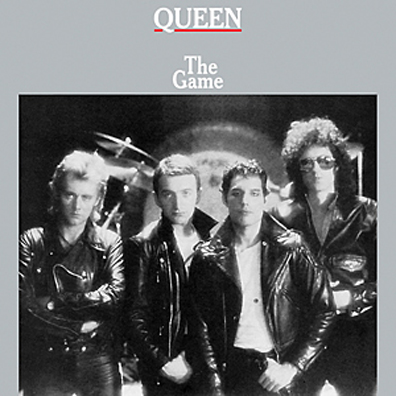
Unconsciously alienating our co-workers with music 101 chats, Krassy and I often playfully argued over whether his favorite Queen album, The Game, was greater than Jazz, my first choice. I'd give just about anything to tell him that we were both wrong. After recently re-discovering A Night at The Opera, it would have killed the competition! — And he'd probably agree. Moreover, since western music was outlawed during Soviet times, Krassy enjoyed hearing me tell stories of various rock and roll act's Stateside debuts, and, in addition, I cherished listening to him relay how these groups secretly penetrated through the communist walls of the Sunflower Capital.
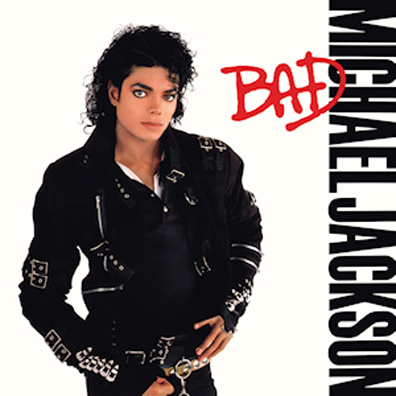
That said, one of the most treasured stories Krassy revealed was his introduction into the wonderful world of popular music in 1987 via Michael Jackson's Bad album. After he was given the sole Bulgarian bootleg of the follow-up to the world's best selling album from a neighbor whom Krassy admirably described as his "music mentor," he instantaneously fell under Bad's charm, prompting the 10 year old to make copies and peddle the Quincy Jones produced record throughout major Bulgarian cities. After hearing such a heartwarming story, I would often credit Krassy for introducing the Sunflower Capital Of The World to the King Of Pop, an accolade that made his usual serious demeanor light up with a smile. Krassy had never been to America, but loved the country as if it were his own. He'd often dream of one day traveling to the States, in hopes of meeting my family — especially my older brother Carlos of whom I'd often say he resembled in personality. Other than his friendly and mellow disposition, perhaps it was because, like Carlos, Krassy was the ideal father to his four year old son, which he fathered with a high school sweetheart. Unfortunately, the couple's brief union ended in a bitter divorce, which often troubled Krassy. But despite the failed marriage, he made a point of alternating weeks between his ex-wife to spend time with his son. With that said, this made the news all the more unbearable, after Krassy disclosed his diagnoses of advanced stage melanoma to me. Though my towering friend fully understood the severity of the illness, he remained extremely optimistic and fought hard up until the final hours of his life where he peacefully passed away at his childhood home in Nova Zagora on the morning of February 27, 2013.
"One by one
Only the good die young
They're only flyin' too close to the sun
And life goes on without you..."
— Brian May, 1997
THE DAY AFTER THE SPACE SHUTTLE Challenger disaster was a day of deep mourning at Thomas Johnson Middle and the world over. The school seemed to have been on manual mode, as grief counselors were made available throughout various classrooms to assist students and fellow co-workers of Christa McAuliffe. Several teachers delivered key speeches in the school's auditorium, which would bring about some relief to the disaster. Fast forward to the morning of February 28, 2013 and the American English Academy of Sofia has officially announced Krassy's passing. Although I didn't deliver any uplifting talks on stage, the news did place me in a similar counselor-like position to students trying to make sense out of the untimely passing of their favorite teacher — most of whom had grown up with Krassy. Though difficult at times, I had to be there to support them and remain strong. With that said, no one thought this day would ever come to pass. Many, myself included, assumed Krassy would ultimately beat the cancer.
COUSIN ERIC'S FUNERAL OCCURRED several days after he was murdered. It was the first time I'd ever attended a funeral. At first I didn't want to go, but mom relayed the importance of saying goodbye to a loved one, and stressed the vitality of supporting the living. At the time, I had no idea what she was talking about. "If they're alive," I reasoned, "why in the world would they need support?" Despite the confoundedness, I could feel the serious nature of my mother's words, so I trotted along with my older siblings and grudgingly attended my cousin's funeral. Upon approaching my friend Krassy's memorial service, that same funeral shy 13 year old would jump right back into my body. I didn't want to go. It wasn't until the morning of the burial that I'd recalled my mother's words once again, which inspired me to attend my friend and colleague's goodbye service. Moreover, 25 years on, it wasn't until I was at Krassy's funeral, when I could fully comprehended the meaning behind the conversation I had.
"You're the best friend
That I ever had
Been with you such a long time
You're my sunshine
And I want you to know
That my feelings are true
I really love you."
— John Deacon, 1975
IF YOU WANT TO BRING FLOWERS TO the departed at a Bulgarian Orthodox memorial service, there must be an even amount of them placed on the grave. Most Bulgarians attribute this even-over-odd tradition with the Sunflower Capital's overtly superstitious past. With this in mind, Sarah readied me beforehand with an even number of lovely long stemmed white roses, then I gassed up Xena and headed out solo to Nova Zagora. When I finally arrived and began to file through the sizable funeral procession, which was held in the living room of Krassy's childhood home, from a distance I could see his parents of whom I had yet to meet. They were tearfully distraught, but graciously greeting guests, who were bidding a final farewell to the Yordanov's only son, who lay in a wooden Orthodox casket, looking quite unrecognizable, as he was noticeably absent of the typical embalming burial methods — either for financial reasons or time restrictions, as the Bulgarian Orthodox religion includes a strict tradition of burial soon after death. Whatever the case, all the reasons why I don't like to attend funerals would make an appearance — mainly plenty of sad and crying faces, which included a heartbreaking vision of Krassy's ex-wife, who was immediately ushered from the procession after repeatedly crying out "that's not Krassy!" (in Bulgarian). Krassy and I were close friends. But like typical straight males, we never expressed just how much we appreciated each other's company in life. So, when I finally reached his coffin, all the things we didn't convey would somehow magically come to light. You see, Krassy must have showed his parents a photograph of me, because they were instantly revived when I entered the room; soon after embracing me with hugs and Bulgarian style kisses, as if I were their long lost second son.
Not realizing I spoke about 100 words of Bulgarian, Krassy's parents started freely speaking in their native language. Thankfully, Tsveta, my friend and principle at the American English Academy of Sofia, was there by my side to help interpret. As I stood there holding up the funeral procession, feeling quite embarrassed of the unwanted attention I was receiving at my best friend's funeral, Krassy's parents relayed just how much my friendship had meant to their son and how, with each visit, he'd share many wonderful stories of me. I too was able to finally express my feelings for their son, as well. In addition to seeing that my good friend acquired his enormous height and sincerity from his father and that loving, easygoing carefree spirit from his mother, in that brief meeting with his parents I also discovered why my mom said, "funerals are to support the living." Anyone could notice that Krassy's parents were truly pleased to see me, and, even if it was just for a brief moment, could see that the grieving couple could use a smile.
"Those were the days of our lives.
The bad things in life were so few.
Those days are all gone now,
But one thing is true.
When I look and I find,
I still love you."
— Roger Taylor, 1991
DRIVING HOME FROM THE FUNERAL, WITH the sounds of Queen blasting full volume, I reminisced over the countless good times shared with Krassy. Attending Bulgaria's most noted musical festival known as Kavarna Rocks (where Krassy once shielded my girl from the north country from the rowdy metal moshing crowd — see Episode 36) or simply having a laugh at school instantly dried my tears.
However, the best and possibly funniest moment that I won't forget was during one of our many shopping days. You see, in addition to a mad passion for music, Krassy and I shared a common interest in all-things fashion. On a weekly basis, he'd often compliment my outfit and ask, "where'd you learn how to dress like that?" My usual response was "The Beatle's, dude!" He'd flash that slight smile and nod, "you couldn't have chosen better fashion models." With the Beatles in mind, on this particular outing I was anxious to get my best Bulgarian friend's opinion on a Sgt. Pepper's... style shirt I had discovered at The New Yorker, Krassy's all-time favorite shopping chain. A mandatory school rule is to address each other as "Mr." or "Ms." which made it both natural and habit forming to call Krassy (or any other co-worker) as such — even outside of the school's grounds. After trying it out for size, I yelled out, "check out this shirt, Mr. Krassy!" as Bulgarian shoppers looked on as if to say, 'why is this American being so formal?' When Krassy, who was on the other side of the store, finally approached, he crouched down to my level to be clearly heard. Looking me straight in the eyes, he insisted, "It's just Krassy. We are no longer at school."
"All dead, all dead
But I should not grieve
In time it comes to everyone
All dead, all dead
But in hope I breathe
Of course I don't believe
You're dead and gone."
— Brian May, 1977
THE SUBJECT OF DEATH IS A REAL DOWNER to discuss, I know. And believe me, I initially didn't want to introduce the topic to the usual upbeat and happy-go-lucky Blog-O-Daria series. But on the day of the announcement of Krassy's passing, it would be a distraught 10th grader who unconsciously changed my perspective on the matter.
As the shy and soft spoken female sat dazed and confused in a corner outside of my classroom, I tried offering her a few words of comfort. However, before I could utter a single one, she cried out, "this really sucks, Mr. Owen! When a person dies, they're just gone and forgotten — forever!"
I'll admit, at first I didn't know what to say. I thought to myself, "unless you're the President of the United States or some famous rock star, in many ways what she said is correct." But there was no better time than now to start changing this bleak outlook in the hearts of young minds. I suggested, "if what you say is true, then it's up to us to keep the memory of Krassy alive."
She shrugged and wiped away the tears. But I could tell she understood.
"Farther along, we'll find our way, through all of the darkness today. The Sun of Reality has dawned above eternity. Now, even the desert will bloom."
— James Seals and
Dash Crofts, 1974
A long time ago in a country far, far away from Bulgaria. . . . It's the period of Jimmy Carter. Oakland Raiders, striking from a Rose Bowl, have won their first victory against the evil Minnesota Vikings. And during the Spring of 1977, three months shy of the death of Elvis Presley, my dad polished up his navy blue Cadillac Eldorado convertible, and took me and my baby brother Jamie to see a film that changed my life forever. As the house lights went down at the AMC Theaters at Landover Mall shopping center in Landover — a suburb of Washington, D.C., I recall not really knowing what to expect. My folks had taken me to the cinema many times before, but on this particular occasion everyone in attendance seemed far more excited than usual, including my dad, who was always too cool to conga.
After seeing Star Wars, my all-time favorite film that really needs no introduction, it magically brought out the inner artist in me — more so than any other visual art piece. Six years on, after two successful follow-ups, including 1980's sequel of all sequels The Empire Strikes Back and 1983's Return of the Jedi, the Star Wars trilogy was now more than just mere entertainment. Now, I certainly don't consider myself a spiritual person, but the films' storyline consisting of good overcoming evil symbolized a way of living and became something of a personal religion for me.
The secret of Star Wars' impact is owed to creator and writer George Lucas, my hero and biggest art inspiration, who opted against using the usual Hollywood back studio lot location for the film's fictional planet known as Tatooine. Instead, Lucas and set designer, the late great John Barry, sought out distant, exotic destinations, eventually discovering the otherworldly terrain of the Sahara Desert region of Tunisia.
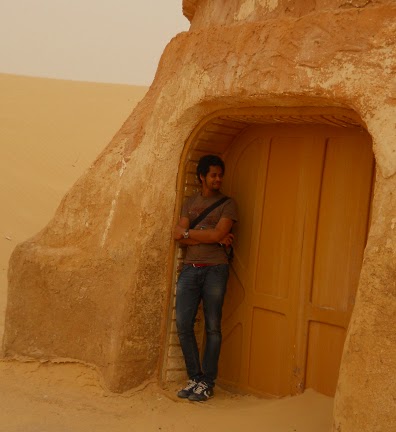
I can still recall being astounded by the introduction of Luke Skywalker, the film's main character, as he stood — with one hand on his knee and the other on his hip — in front of an igloo-like desert home dreaming of someday becoming a Jedi and traveling to distant planets. The certain dystopian nature of the mise en scene not only transported this six year old kid to 'a galaxy far, far away,' it was the prototype that sparked the traveler in me. In fact, the scene was so influential that in every photograph from that period, I'm striking an identical pose. With this in mind, fast forward 35 years later; Princess Sarah and I take an unexpected journey to the northern most region of the Motherland in search of Luke Skywalker's home. During our quest, we happen upon a wise man who would be our only hope in surviving the recent revolutionary ridden streets of Tunis, as well as a death defying drag race through the Sahara Desert, and later on, he ultimately rescues the Princess, who mysteriously vanished inside the creepy catacombs of Sousse. Read on, you must . . .
"Diamond Girl
You sure do shine
Glad I found you
Glad you're mine"
— James Seals and Dash Crofts, 1973
THERE'S REALLY NO PLACE LIKE HOME. AND over the past holiday season, I did just what the doctor ordered and returned to the good ol' U-S of A for some needed R-E-S. and T. Usually, after a wonderful and relaxing visit, catching up with friends, family, New York City and my Bad Boy, it's easy to fall back into an old routine, which makes it difficult to return to the Sunflower Capital of the World.
This time around, though, I was pretty anxious to get back. You see, days before our Stateside return, Sarah signed us up for a Bulgarian-based charter tour to Albania, a south western Balkan country that had been on the top of my most sought after destination's list since first arriving in Bulgaria over three years ago now.
Unfortunately, my dream destination was put on hold. On the night before the departure, the agency canceled, due to a lack of ticket sales. Having been psychologically prepared and physically packed, Sarah wasn't placing the trip on the old back burner. Like a panic seller in fear of a stock market crash, my girl from the north country scrambled for an alternative tour to Albania.
Yoda, the Jedi Master would say, "the dark side clouds everything. Impossible to see, the future is." Because, after a couple of hours glued to her MacBook Pro — world's best computer, Sarah purchased at my insistence — she was unsuccessful in locating an alternate route to Albania, but lucked out and found the only two remaining seats on a super-discounted tour of Tunisia. Hey, nothing against Albania, of course, but as previously stated, due to my allegiance to Star Wars, Tunisia had special meaning since 1977. So without further delay, Princess Sarah punched purchase and presto, I was on my way to a dream quest for Luke Skywalker's home.
"See the curtains hangin' in the window,
In the evenin' on a Friday night
A little light a-shinin' through the window
Lets me know everything is alright."
— James Seals and
Dash Crofts, 1972
"IN A DARK PLACE we find ourselves, and a little more knowledge lights the way," Yoda wisely said. So, other than my brother Thad and his wife Dawn once visiting in the late 80s, beforehand, my knowledge of Tunisian culture and geography was pretty dim. With that said, a couple of hours after rebooking, I took a Google quickie crash course to shed light on the subject. And like Yoda, I always pass on what I have learned . . .
Equal to the size of Wisconsin, The Republic of Tunisia's population contains 3 million more than Bulgaria's 7 million and is located about 1,000 miles southwest of the Sunflower Capital. It borders Libya to the southeast, Algeria to the west, and the Mediterranean Sea to the north and east. Because of the latter, the northern most region of Tunisia experiences a Mediterranean type weather pattern, consisting of hot summers and rainy winters — whereas, the southern most part is dominated by desert.
Despite the two different terrain and temperatures, a major majority of Tunisia's population speaks Arabic and follow the Islamic faith, while a tiny percent abide by Christianity and Judaism. From my observation, a majority of older women wore traditional head-scarfs, and the older male population were often decked out in dark three piece suits — even during scorching hot days. Furthermore, Tunisians, who proudly claim soccer their national sport and enjoy a traditional diet of yummy couscous and delicious dates, were quite beautiful people — inside and out — and often made me and Sarah feel right at home.
Two years shy of the quest for Luke's Home, a revolution resulted in the dethroning of Tunisian dictator Zine El Abidine Ben Ali. Although the country has since started its first free elections — with no chance of reverting to authoritarianism — there was still a sense of unstableness. Due to our American status, Sarah and I were also strongly cautioned against traveling about the country on our own and advised to stay with the tour group. Seasoned and stubborn, we weren't at all thrilled about the idea. But a solution, we stumbled on. . .
"Like Columbus in the olden days
We must gather all our courage
Sail our ships out on the open seas
Cast away our fears"
— James Seals and
Dash Crofts, 1973
AT THE START OF our quest, Yanitsa, a highly recommended tour guide for Astral Holidays — the oldest chartered tour in Bulgaria — cheerfully greeted us at the doors of Sofia National Airport. After a two hour flight on Bulgarian Air Charter, we arrived in Tunis, the capital and largest city of Tunisia, where we took a short bus ride from the Tunis-Carthage National Airport to our castle like coastal accommodation. Due to the hotel's humongous size and to protect the identities of the innocent, I shall refer to it as the Death Star.
Not at all liken to Darth Vader, the Death Star was operated by an abundantly welcoming Tunisian entrepreneur named Hedi, which brings to mind my ever-so-present celebrity status, once again. You may recall my first time in North Africa was a solo adventure to Egypt, a country where I could easily pass for a native. With this in mind, although the typical Tunisian hair-type is straighter than the general curly locks of an Egyptian, my tall, slender frame and caramel colored complexion made it easy to blend into the Tunisian canvas. However, like me on a daily basis in Bulgaria, Sarah, with her blonde locks and nordic skin tones, was the big star in Tunisia.
In the mouth, never look a gift horse. Because whatever the case was, the celebrity situation would get challenging. After Sarah or I would reveal our American status, Tunisians from all walks of life would seemingly treat us like royalty. However, when perusing any Third World country, the toughest part is trying to determine who's cool because they're genuinely happy to meet an American or who's kind because they're simply out to get something in return. For example, an outgoing Tunisian chef named Amen was the toughest in determining this.
Soon after I arrived, Amen took a huge liking to me, so much so, that during the Death Star's free dinner hour — which was part of the Astral Holiday tour package and consisted of a yummy all-you-can-eat style buffet — he'd cook a meal exclusively for me that wasn't on the menu! As scrumptious as it was, when folks, including Hedi, started to take notice, the situation became unbearably embarrassing and I even feared for Amen possibly losing his job.
One night after dinner, while politely trying to get Amen to take a chill pill on the extra frills, he simply refused and offered an additional invitation for me and Sarah to join him on his uncle's Yacht. In fact, this seemingly apprehensive request occurred every night during the duration of the quest. Okay, I know what you're thinking, but hold that thought — I'll revisit the subject in a moment. But first, on to that only hope I mentioned earlier. . .
"Strong is the light of unity
It can light the world for you and for me
So why don't we reach out
and be one planet, one people, please?"
— James Seals and
Dash Crofts, 1980
WITHOUT WATER AT MY BEDSIDE, SLEEP I cannot. You see, in hopes that customers will break the seal on the high-priced mini-bar, most hotels frown upon bringing in a stash of H2O — an unwritten rule I often break. Well, besides drinking it, this little habit finally paid off. You see, while trying to smuggle in a record number of 8 super-sized bottles, Sarah and I were promptly revealed and stopped at the entrance of the Death Star. Salem, a tall, good-looking Tunisian hotel security guard — or in this case, Stormtrooper — in his early 40s, who spoke perfect English, escorted us to the main office for questioning — so we thought.
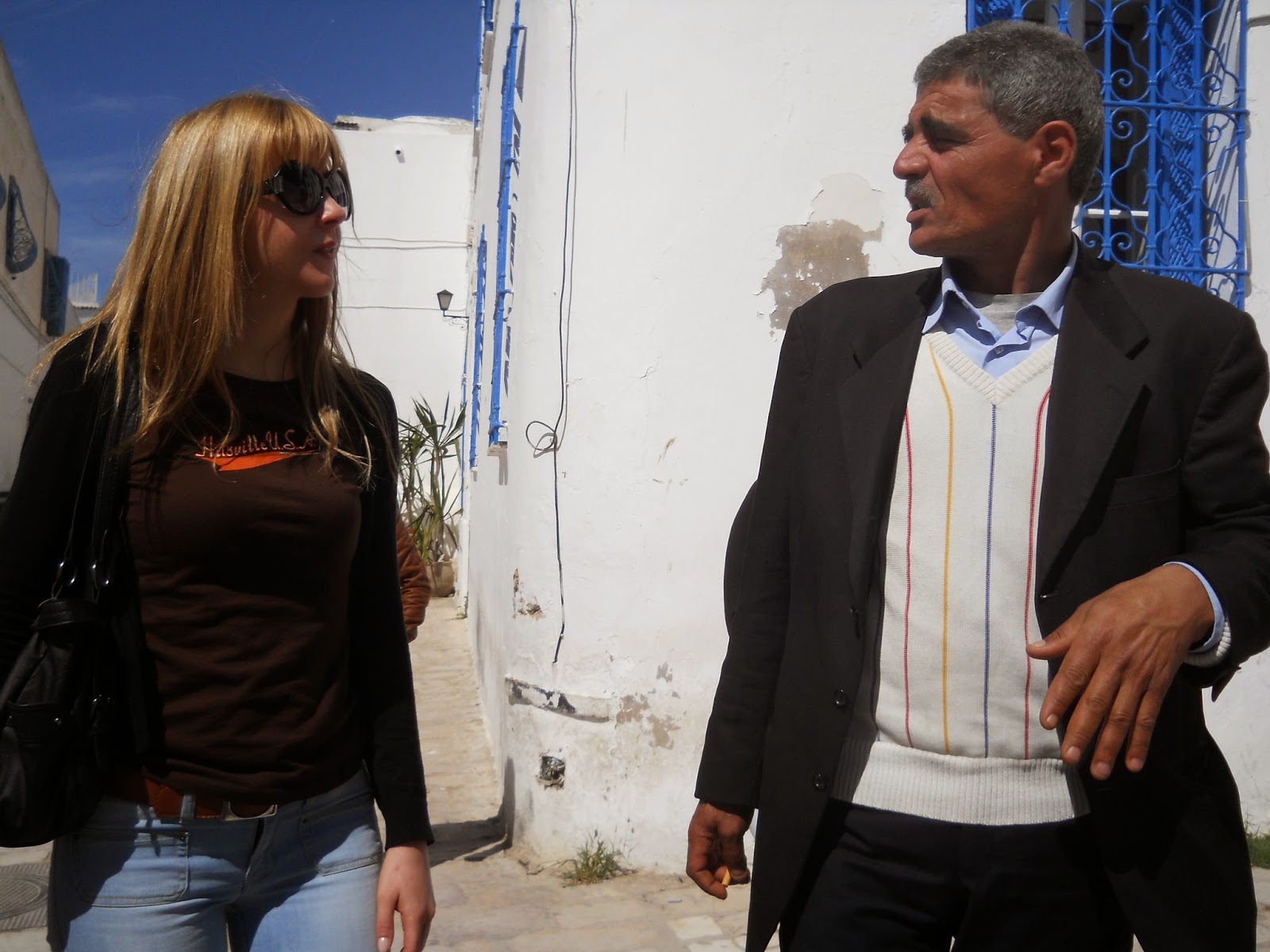
Once inside, Salem, who expeditiously dropped the usual tough officer demeanor and adopted the disposition of the wise Obi-Wan Kenobi, warned us that "the hotel forbids more than one bottle of water" and solemnly promised to deliver the rest to our room during the night. After graciously thanking him, Seasoned Sarah, who was more bummed-out about traveling the country with a tour group than I was, curiously asked questions regarding exploring Tunis on our own. Particularly, with regards to catching a bus to the city center. With a worried brow, Salem warned of the possible difficulties, then advised hiring a personal guide to safely escort us there. After agreeing, Sarah requested information on obtaining one, when Salem interrupted to offer his own personal services. With an immediate sense of trust, Sarah and I quickly took him up on his proposal. Hotel workers offering this type of service is strictly forbidden. So the next morning, after covertly maneuvering around the Death Star's security office, Salem met us at a nearby bus stop, where we started our quest.
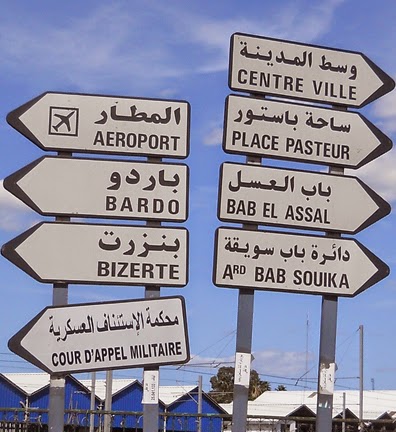
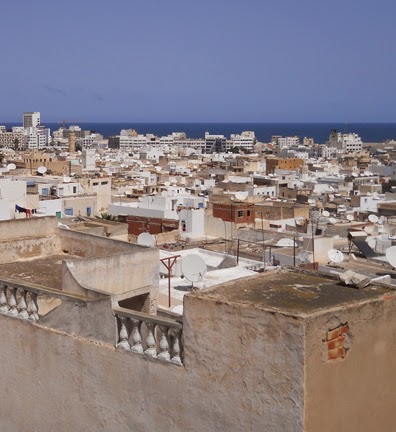
After cabbing through the most dangerous driving and crazy congestion imaginable, some of the many attractions visited were Al-Zaytuna Mosque, the captivating Carthage, Kasbah Square, the roofs, souks, and alley ways of medina open-air market, Avenue Habib Bourguiba and Bab el Bhar Gate — the Champs-Elysees and Arc de Triomphe of Tunis respectively — and last but certainly not least, the stunning Bardo National Museum, which featured a mountain of magnificent mosaics that made Sarah's mouth melt.
"So let your sweet rain fall on me,
for I am dying
We're desert people and we're in pain,
but were still trying
We've been down so long,
we are dry, we are thirsty
So you see the rain we must have,
is the tears you shed long ago"
— James Seals and
Dash Crofts, 1974
EXHAUSTIVE, THE CITY TOUR WAS, WHEN Salem helped locate a Tunisian football jersey I'd been hankering since the start of the quest. And later in the evening, the three of us relaxed and sipped on tasty tea inside a cafe where we got personally acquainted. Next to learning that we were both fans of Kojak (yeah, I too was surprised the gritty detective series aired in Tunisia during the 70s), Salem gave us the 411 on his country and even cautioned against accepting Amen's yachting invitation. Ironically, not long after his stern warning, he'd hit us up with a request we'd both been fearing since meeting the wise gentleman.
Well, remember I told you that it wasn't easy determining honest Tunisians from insincere ones? We'll, that just got extra complicated. After Salem relayed heartbreaking stories of family struggles and hardships, he spoke of an only hope for survival; a son, who was currently attending university. After Sarah and I released a relieving sigh, Salem, however, spoke of one obstacle that could hinder his son's chances for graduation; a computer that had recently broken.
As sincere as Salem's plea was, afterwards Sarah and I admitted to not being certain if we were being taken for ride. Sure, had we known if Salem's story was legit, we would have probably bought him a computer on the spot. But how can one be sure in these types of situations? So, instead of handing Salem cold hard cash, Sarah, who was cool under pressure like only a princess could be, eased a potential awkward situation of rejection. Since she had just purchased that new MacBook Pro, it was a no-brainer to simply offer Salem her older PC unit.
However, after deducing that sending a computer over a possible corrupt Third World postal system may result in theft, the idea was like water under the bridge. But before completely giving up, we exchanged addresses in case a solution came to mind.
"... But there's always
Some mighty friendly faces
Waitin' to greet you at the door"
— James Seals and
Dash Crofts, 1974
ANYBODY OUT there speak Russian? Because this is where I mention after signing up for a two-day Sahara Desert tour in hopes of locating Luke's home, we'd discovered that the tour was given in Russian. Due to this nature, besides meeting some cool Bulgarians; Nelly, Evilena and Radoslava, we got well acquainted with a host of remarkable Russians studying to become Tunisian guides, which included Lyuba, Max, Sergey and my boy Demi, who would be liken to Skywalker's ace in the hole — Han Solo — on our quest for Luke's Home.
After relaying the search to Demi over lunch at a delicious date palm themed shop and restaurant, the hopeful Russian guide was quite eager to join in. So, naturally, we began our quest by first asking Muhammed, the Sahara tour guide who spoke a little English. Like nearly every Tunisian we'd encountered, he knew nothing of Star Wars, let alone Luke's home. Since I'd once visited North Africa, I should have known better, as there was an absence of general pop culture knowledge in Egypt. On the other hand, although Tunisians hadn't heard of the world's most popular film — which was mostly shot in Tunisia — I was pretty thrilled to know that they were quite familiar with the King of Pop, who's posters were plastered on many walls throughout the city.
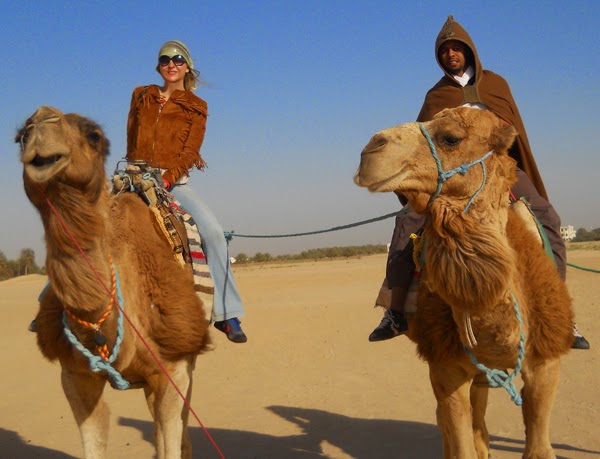
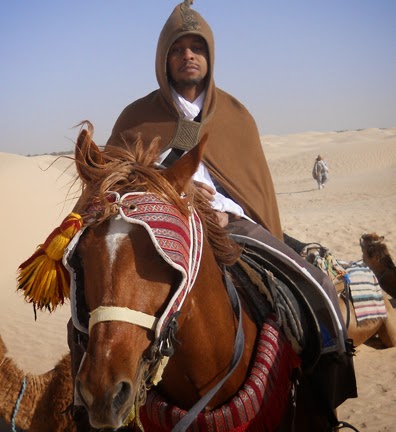
At this juncture, though I had yet to locate Luke's home, the tour took a pleasure ride on dewbacks and tauntauns... uh, sorry, correction... I mean, camels and horses through the Sahara and later stopped off at Tunis Zoo, which featured many exotic African animals, where I climbed to the top of a date tree. In the evening, we put the camels to rest and, on foot, explored Sarah's favorite great Mosque of Kairouan, one of the most important mosques in Tunisia, located in the small town of Kairouan, a UNESCO World Heritage Site. Kairouan also boasted a unique Tunisian style graveyard, which quenched this Jedi's cemetery searching thirst.
However, the Astral Holiday's highlight was a death defying, daredevil jumping, jeep drag race through the Sahara, where we explored many original Star Wars' film sets. Because the majority of my readers are not Star Wars fans, without going into glorified geek detail, the tour included quite a few natural locations like Yardangs, Juntland Wastes, Sith Infiltrator landing site, and Lars Homestead (the interior shot of Luke's home), which is now used as a hotel in Matmatta.
Surprisingly, some Lucas-made locations were left behind as well. Iconic Star Wars locales such as Watto's Shop, Sebulba's Cafe, and the market place in the town of Mos Espa were purely surreal to see simply hanging out in the middle of the desert. With this in mind, although Tunisians have never seen or heard of Star Wars, they do understand the profit of tourism, as they left the props standing for value's sake. On that note, if you are a huge Star Wars fan, get there soon before Tunisians, or some other uncontrollable entity, change their minds.
Understanding that all great artists are hopeless thieves at heart, the original concept for Tatooine and the Jedi Knight's robe were simply filched. You see, Lucas pinched the name and cloak idea after roaming around Tataouine, a cave dwelling town where one can easily spot friendly Tunisian men known as Tuareg People, donning dark colored hooded wizard-like gowns.
Though these robed Tuareg men may be sporting beards and carrying a long dagger, don't be fooled into thinking they're one of those silly Star Wars freaks — ruining it for subtle fans — dressed up for a premiere or comic convention. No, they're simply wearing a traditional North African burnous, which was around long before Lucas was born. That said, though quite pricey, I purchased one as a souvenir and ended up becoming a celebrity after all in Tunisia, as many tourist often requested photographs taken with me.
Although I located the interior of Luke's home, I wasn't satisfied until I'd found his little igloo that captivated me as a child. So, now it was time to start the real search. Because the tour was off in the morning, Sarah slept in our temporary hotel accommodation, while Demi and I stayed up hours through the night in search of Luke's home. Like Solo, Demi was excellent at wheeling and dealing top dollar to bounty hunters... uh, correction again... I meant to say, Tunisian cab drivers, who were willing to help locate the igloo.
Though Demi tried his best, in the end, I wistfully came up empty handed. Muhammed explained, "due to the igloo's tiny size, it would be nearly impossible to locate in the Sahara — especially during the night." However, he and another helpful Tunisian from the hotel, were more than certain that Luke's home was near the salt pans, flat expanses of ground covered with minerals, which would be our final stop in the Sahara. This location was a fact that I had previously researched.
Unfortunately, it was just a short pause; leaving only a minimal amount of minutes to implement a thorough search of the salty surface that seemed to run for miles. Alas, with no other choice in the matter, I simply handed Princess Sarah the camera, walked out as far as time permitted, and struck that iconic Skywalker pose that I often imitated as a child. Although the little igloo was no where in plain sight, knowing that it was somewhere nearby warmed my heart.
"It's gotta be soon
So let it cool awhile
Slow down, easy style
And you'll be doin' alright,
'cause you love"
— James Seals and
Dash Crofts, 1972
AFTER A COZY coach ride back, gazing out at the final flashes of the Sahara while listening to the musical sounds of Seals and Crofts on my little R2-D2... sorry, I did it again, correction... I meant, Little Silver — my trusty iPod, the next stop explored was the town of El Djem (pronounced like 'Jim'), located in Mahdia Governorate and Thysdrus, home of the most stunning Roman amphitheater I'd seen since Italy's Colosseum. Luckily the tour arrived super early, which resulted in us having the usual tourist heavy stadium all to ourselves, giving us plenty of time and space for picture taking.
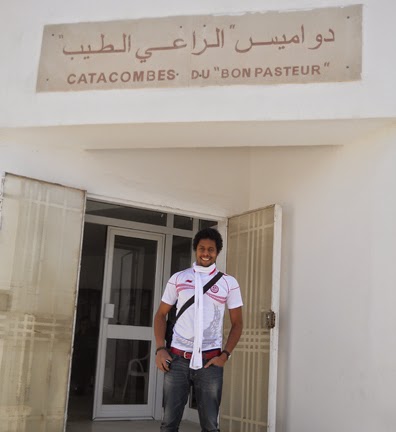
As the tour neared its end, we hooked back up with my boy Salem for one last adventure and headed for a small city south of Tunisia called Sousse. Upon arrival, we visited the Archaeological Museum, the world's second largest mosaic gallery ever after Bardo, which made Princess Sarah's mouth melt once more. Though the mosaics were impressive, we both agreed that the most memorable aspect of Sousse was its infamous catacombs. Initially, the curator showed us a small section permitted for tourists, as the deeper part, which included the serious artifacts, was under construction and considered hazardous.
This, of course didn't satisfy the Princess. So, to Salem's and my surprise, she did some heavy flirting (and backsheesh-ing apparently) and presto, the museum curator took us deeper inside the dark pits of catacombs where the atmosphere got quite frightening. Thankfully, after coaxing Salem, who usually waited outside during our tours of museums, he agreed to join us. Even luckier for the Princess. Because during the curator's excellent exploration, Sarah, who, like her dad, tends to wander off when exploring museums and landmarks — possibly to get more out of the experience — mysteriously vanished inside one of the gaping tunnels.
I'm not going to lie. After calling out her name several times, I panicked like C-3PO during a Stormtrooper raid. However, Salem, who was, after all, a security officer, put those Kojak watching skills to good use. You see, before entering the catacomb's dark menacing maze, he'd taken careful notice of items that had been dropped on the surface, which trailed back to the entrance. Using these skills, he somehow managed to locate my Princess from the north country hanging out studying various artifacts in a dark corridor. After Sousse, we headed back to the Death Star and bidded a final fond farewell to our friend Salem and his beautiful country. But with one hour left, before leaving for our flight, Sarah and I took a lovely walk on the captivating coast of Tunis and reminisced over our quest, and afterwards stopping off ate a tasty Tunisian style pizza joint on the boardwalk.
"'Cause you make me feel like I'm more than a friend
Like I'm the journey and you're the journey's end
I may never pass this way again
that's why I want it with you"
— James Seals and
Dash Crofts, 1973
YODA SAID, "MANY TRUTHS WE CLING on to depend on our point of view." A few months after the quest for Luke's home, Sarah and I received a heavily stamped, handwritten letter in the post box. It was a short note from our friend Salem, who was basically apologizing if his plea for the PC seemed to have come off as dishonest. He wrote: Dear Owen and Sarah, How are you? Hope you are well and healthy. Hope also that your family and friends are okay. You start work? [Is] everything okay? About me here; I'm [doing] some work [at the] same place. No news, only [that] the Summer [has started] and [there are] so many guests and [it's] so sunny. I [thought] a lot before I [wrote] you. Because maybe you think it is for the PC, [and] not for friendship, [which] is why I [took] a lot of time thinking. Hope you understand. Many greetings from me and all my family and [especially] my kids. Thanks. — Salem.
With regards to Salem's request, Sarah and I had been thinking long and hard, too. And not only did we have a change of heart, the timing of the letter was perfect. You see, a week before the letter's arrival, we had been seeking ways of safely delivering the PC and recently came up with the best possible solution. During a lunch outing, Sarah had mentioned our terrific Tunisian quest to our good friend and fellow ex-pat Elana, whom you might recall from a couple of episodes back, when we enjoyed a night at Circus Balkanski. Elana, a fellow adventurer who, like Sarah, is a former Fulbright Scholar and works closely with Bulgarian-Roma relations, graciously took us up on our advice to visit Tunisia. And upon learning that we had been attempting to deliver a computer to our friend, Elana enthusiastically offered up her services and personally hand delivered the PC to Salem.
During her visit, Elana got the same warm presence from Salem that Sarah and I felt and later relayed his deepest gratitude back to us. A sentiment, which was certainly expressed on both sides. Today, when I think of Salem and our great times in Tunisia — moments of which I'll cherish for the rest of my life — I remain hopeful that he and his family are managing through the struggle and poverty. Now, I certainly don't consider myself a spiritual person, but whenever I start to worry over my friend's situation, there's really only a few words that can ease my mind. . . . May the Force be with him, always. Be seeing you. O